



Program Overview
MCC’s $449.4 million Morocco Employability and Land Compact (2017-2023) funded the $107.6 million Workforce Development Activity, which included the Results-Based Financing for Employment and Labor Market Observatory Sub-Activities. These programs were based on the theory that paying job placement service providers based on results would lead to improved labor market outcomes for job seekers, and that improved availability of labor market information through an online platform would support improved decision-making in the Technical and Vocational Education and Training sector.
Download the French translated evaluation brief.
Evaluator Description
MCC commissioned Mathematica to conduct an independent interim performance evaluation of the Workforce Development Activity. The interim report includes final results for the RBF and Labor Market Observatory Sub-Activities. Full report results and learning: https://evidence.mcc.gov/evaluations/index.php/catalog/455.
Key Findings
Labor Market Outcomes of Results-Based Financing (RBF) Participants
- Stakeholders noted that the RBF program provided economically inactive women and youth, underserved by other programs, with short trainings to develop non-technical and job search skills and placed them in formal employment.
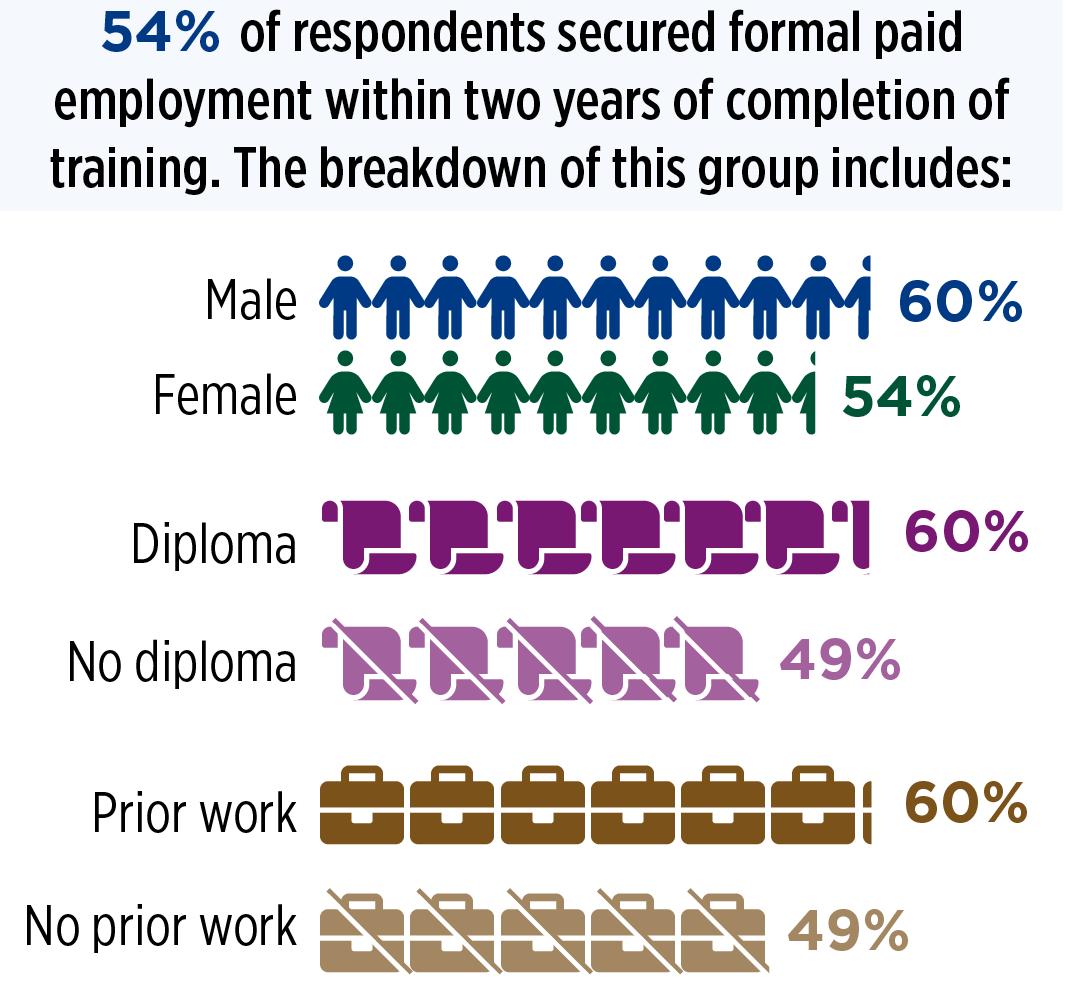
- 54% of survey respondents had held a formal paid job within two years of completing training, and 39% were employed at the two-year mark, with outcomes varying across the eight service providers.
- Women, participants without a high school diploma, and those with no work experience were less likely to be formally employed compared to others.
Potential for RBF Scale-Up
- Some small-scale government job placement programs have adopted and refined the RBF model since the compact ended.
- Scaling up the RBF program model broadly may be difficult due to its complexity, cost and other challenges compared to traditional job placement programs.
Labor Market Platform
- Due to ongoing unresolved disputes over the management and future financing of the data platform, it had not yet publicly launched as of May 2024, and its future remains uncertain.
Evaluation Questions
This interim performance evaluation of the Workforce Development Activity, which includes final results for the RBF and Labor Market Observatory Sub-Activities, was designed to answer the following two questions:
- 1
Has RBF demonstrated an effective model for job placement services that can be continued after the end of the compact? - 2
To what extent has the Labor Market Observatory improved the availability of labor market data to support decision-making in the Technical and Vocational Education and Training (TVET) sector?
Detailed Findings
Labor Market Outcomes of RBF Participants
The program successfully identified and trained unemployed youth, including women and individuals without a high school diploma who are typically underserved by existing programs. More than 5 in 10 program participants secured formal employment in the two years after completing training and almost 4 in 10 were still formally employed at the two-year mark, although employment rates varied greatly by provider and were lower for women and those without high school diplomas or prior employment. The median monthly wage among those with formal employment was 2,900 dirhams (about $290) in their most recent or current formal job, which is similar to the 2023 national monthly minimum wage of 2,902 dirhams.
The absence of a comparison group makes it difficult to fully contextualize these employment outcomes. Nevertheless, the program’s achievements are notable given that: (1) providers worked with unemployed women and youth with limited prior work experience; (2) most participants received only a short period of nontechnical training and job search assistance; (3) the program required placing participants in formal jobs, which is challenging given the prevalence of the informal labor market in Morocco; (4) the program began right before the COVID-19 pandemic which resulted in significant unanticipated labor market disruptions; and (5) some providers did not have previous experience providing job placement services or working with economically inactive women and youth without a high school diploma.
Potential for RBF Scale-Up
Stakeholders viewed the RBF payment model favorably and some small-scale programs funded by the national job placement agency have adopted an RBF model based on the experience of – and learnings from – the compact-funded program. However, scaling up the RBF program’s model faces significant obstacles. Key challenges include complex and costly verification procedures for participant eligibility and labor market results, a need to provide intensive technical assistance and capacity-building to service providers, and a desire for improved access to labor market information and increased private sector engagement.
Labor Market Platform
Under this sub-activity, the compact funded the creation of an impressive online integrated data platform called marssad.ma that has the potential to improve the availability of labor market data and meet the needs of a variety of users including job seekers, job placement service providers, employers, and other TVET sector stakeholders. The platform includes many of the envisioned functionalities, but still lacks access to some key data inputs from institutional partners. Due to ongoing unresolved disputes over the ownership, management, and future financing of the data platform, it had not yet publicly launched as of May 2024 and the future of the platform is uncertain.

MCC Learning
To facilitate the implementation of results-based financing programs as well as their scale up by government partners after the end of MCC support, program implementors need to identify less time-consuming and costly approaches to eligibility and results verification.
Program implementors should carefully consider the incentives that may be created by including disaggregated targets for the purposes of payment under a results-based financing program. MCC in collaboration with its government partners addressed this lesson by amending the contracts to allow providers to surpass the disaggregated targets on women and individuals without diplomas, which renewed providers’ focus on recruiting them.
Future MCC investments in information technology products should clarify intellectual property ownership issues, institutional arrangements, and a plan for post-compact management and financing responsibilities upfront, prior to implementation of the relevant sub-activities.
Evaluation Methods
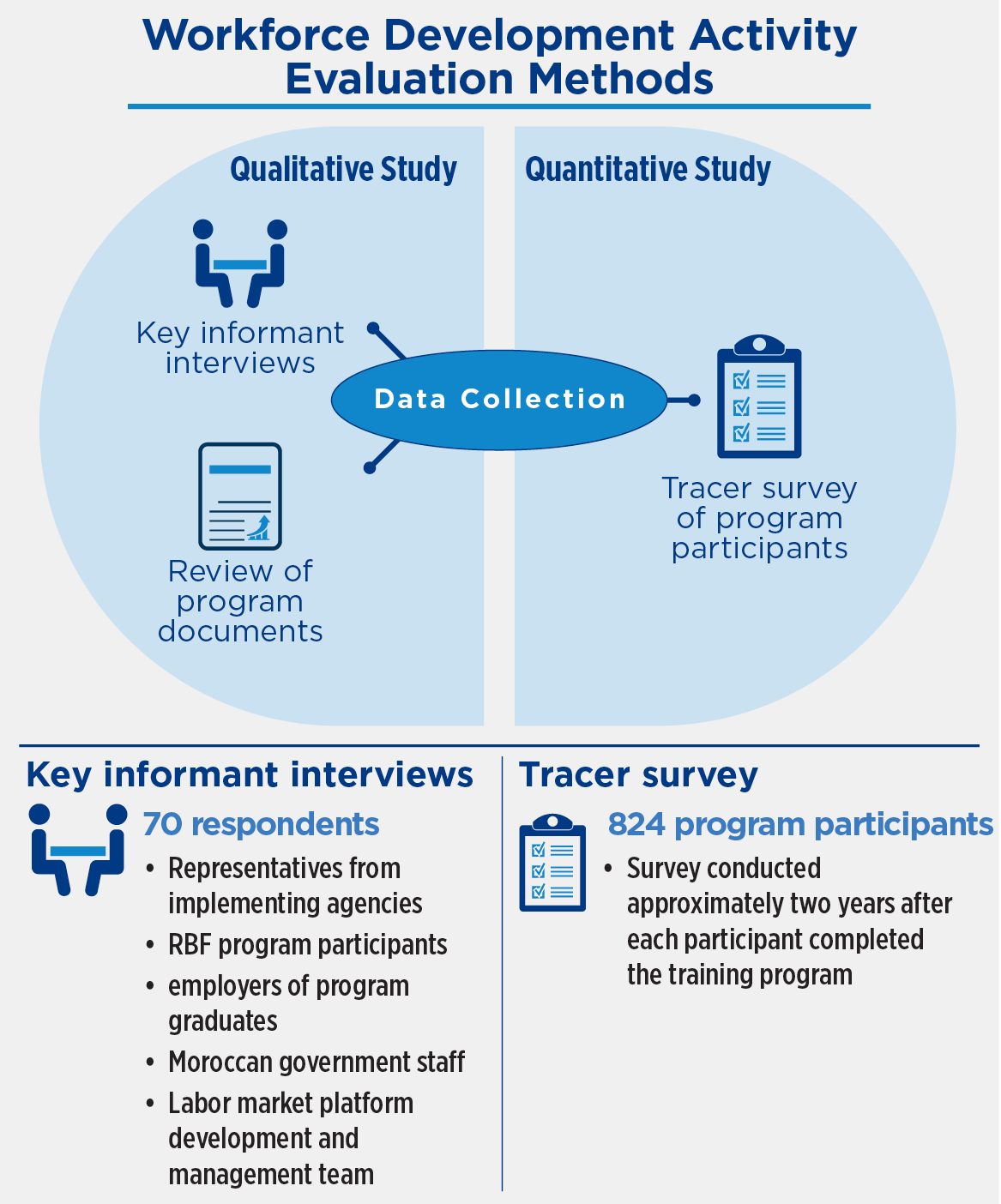
This interim performance evaluation of the Workforce Development Activity has two components: (1) a qualitative study, which describes the implementation of the employment sub-activities and perceptions of whether the investments under the sub-activities will be maintained; and (2) a quantitative descriptive study, which documents the labor market outcomes of participants in the RBF program.
Qualitative study. The qualitative study draws on key informant interviews and document review. The first round of data collection occurred in April and May 2023, right after the end of the compact. It focused on implementation, how implementation might affect outcome achievement and perceptions of the persistence of results or prospects for scale-up. The team interviewed 70 respondents, including representatives from implementing agencies; RBF program participants; employers of program graduates; Moroccan government staff; and the labor market platform development and management team. Mathematica also reviewed program documents related to implementation and took part in a demonstration of the marssad.ma platform. The second round of interviews was conducted in May and June 2024, a little over one year after the end of the compact. During this round, the team re-interviewed Moroccan government stakeholders to discuss the scale-up of the RBF program and the labor market platform development and management team to discuss the potential launch and subsequent operation and management of the platform in the post-compact period.
Quantitative study. The quantitative descriptive study of the RBF program documents the labor market outcomes of RBF participants. The study relies primarily on data from a tracer survey conducted with a representative sample of 824 program participants (about 100 per provider) between December 2022 and February 2024, approximately two-years after each participant completed their training program.
2025-002-3106