




Program Overview
MCC’s $49 million Kosovo Threshold Program (2017-2022) supported open data initiatives and government-civil society engagement through the $7.2 million Transparent and Accountable Governance Project. The project aimed to improve the public availability and analytical use of judicial, air quality, and labor force data by civil society, business, and the Government of Kosovo, thus promoting data-driven decision making.
Evaluator Description
MCC commissioned Mathematica to conduct an independent final performance evaluation of the Transparent and Accountable Governance Project. Full report results and learning: https://evidence.mcc.gov/evaluations/index.php/catalog/9220.
Key Findings
Judicial Data
- The project launched the Open Data Platform and Case Tracking Mechanism through the Public Access to Judicial Information Activity.
- Delays prevented training of civil society organizations (CSOs), limiting uptake of judicial data for analysis and advocacy.
Air Quality Data
- The project fostered engagement between CSOs and government via the launch and training on an air quality monitoring platform.
- Post-project, platform breakdowns affected public uptake and trust in the data.
Open Data Innovations
- The Kosovo Open Data Challenges allowed grantees to analyze government data and produce data-driven tools for public and government use.
- Most grantees’ innovations—and their relationships with the Government of Kosovo—are no longer active.
Data-Driven Decision Making
- The Government of Kosovo appears unlikely to use non-governmental analyses and evidence in decision-making.
- The project made limited progress in increasing public trust in, and understanding of, the government’s functions.
Evaluation Questions
This final performance evaluation was designed to answer the following questions:
- 1
Judicial Data: Was the activity implemented according to plan? Did the activity achieve its objective – the analytical use of judicial data – by October 2022? - 2
Air Quality Data: Was the activity implemented according to plan? Did the activity achieve its objective – the analytical use of air quality data – by October 2022? - 3
Open Data: Was the activity implemented according to plan? Did the activity achieve its objective – the analytical use of new datasets – by October 2022? - 4
Did the project promote data-driven decision making within the Government of Kosovo?
Detailed Findings
Judicial Data
Mechanism for parties with active court cases based on a needs assessment with CSOs. However, the implementation diverged from plans in both the timing and quality of outputs. Early delays meant both platforms were launched more than a year later than planned, at the closure of the project, and the project never gave CSOs planned trainings on the Open Data Platform. Once launched, the platforms had at least two system outages, and some platform datasets and visualizations were low quality and not user-friendly.
These challenges limited progress toward the activities’ target outcomes. Qualitative data suggest that CSOs did not widely use the newly-published judicial data for analysis and advocacy by October 2022, and the Government of Kosovo’s use of CSOs’ analyses for decision making was limited. Regarding the general public, Public Pulse Survey data from the United Nations Development Programme show that changes in access to judicial data were not accompanied by rapid or widespread improvement in public trust in the judiciary (see figure below).

Public perceptions of the Kosovo judiciary
Air Quality Data
The project activity focused on air quality data produced an emissions inventory, a live air-quality platform, and trainings on the platform and improved CSO-government engagement during the activity.
However, after Transparent and Accountable Governance Project, challenges in transferring the air quality platform to a new operator caused lapses in the platform’s functionality and trust in data quality and availability. Consequently, the analytical use of air quality data by October 2022 was not evident as expected.
The findings also show where and when three key pollutants exceeded EU-established safety thresholds, and where there were insufficient data to credibly compare values against standards. Because project-funded stations reported insufficient data for many seasons, years, and pollutants, it is not possible for policymakers, CSOs, or residents to consistently draw actionable conclusions about pollution from these data (see figure at right).
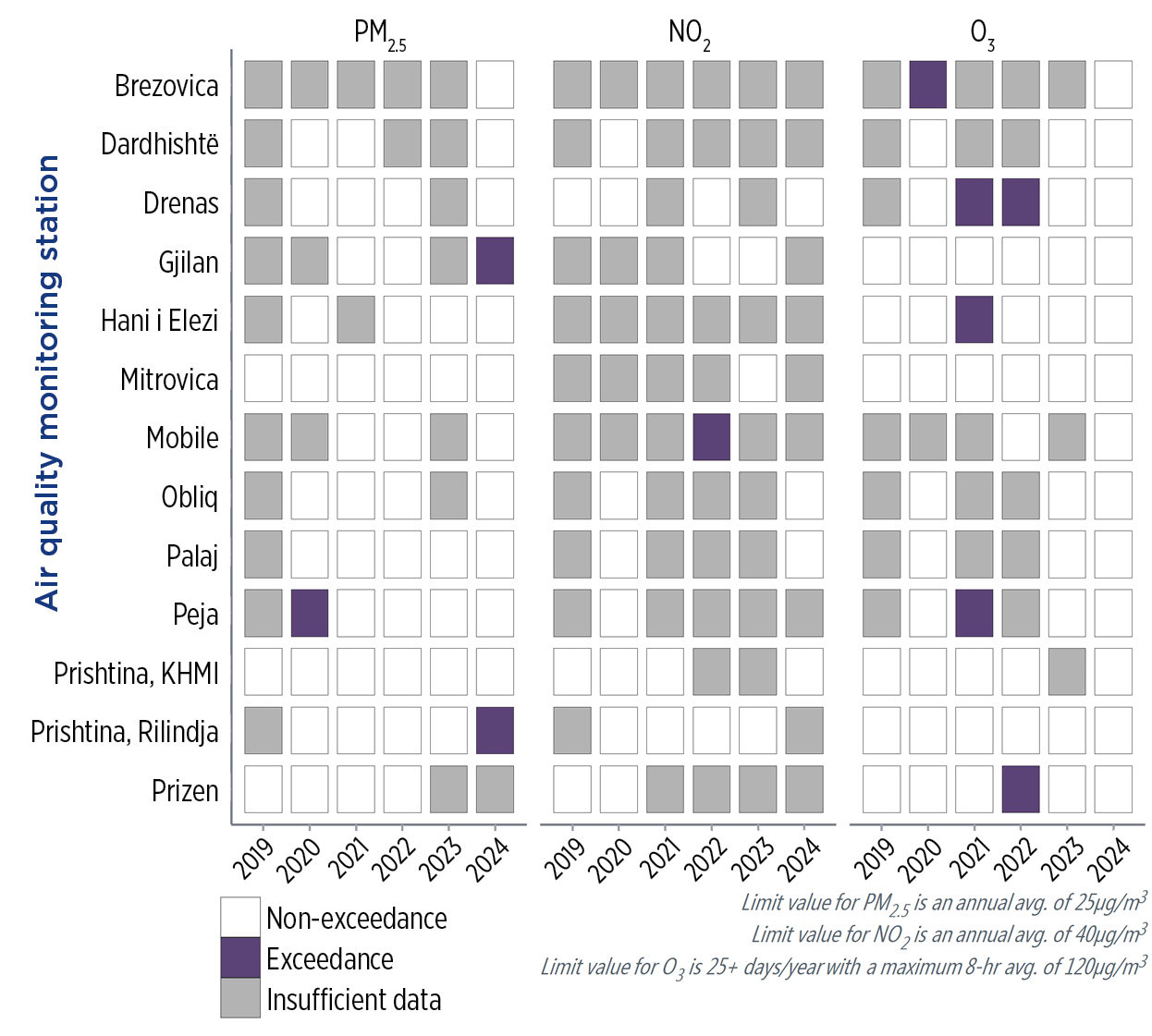
Instances where air quality data were missing or showed pollution exceeded standards.
Given these gaps, it would be reasonable to observe limited uptake of the platform’s data offerings. Indeed, web traffic data on the platform shows low weekly traffic relative to Kosovo’s population, high variation in traffic from week to week, and no consistent increase in platform visits in the winter months, when air quality tends to be worse and public concern about air quality grows. This suggests residents did not rely on the platform to inform their views.
Open Data Innovations
As planned, civil society and private sector actors used grants through four open data challenges to analyze government data and produce data-driven tools for the public and government offices.
Government institutions and the public used several grantees’ innovations for decision making during the project period and by October 2022. However, in the years since the open data challenges concluded, most grantees’ innovations became inactive and their relationships with government institutions waned. The evaluation found that without a convening grant or donor actor to promote engagement and collaborations, institutions lacked the incentives to maintain partnerships for data usage.
Data-Driven Decision Making
The Transparent and Accountable Governance Project partially succeeded in improving the availability of data for the public, stimulating engagement between the Government of Kosovo and civil society during the project, and fostering the analytical use of open government data by civil society and government actors.
However, this evaluation found no clear evidence of increasing engagement between the Government of Kosovo and CSOs and media organizations after the Transparent and Accountable Governance Project. Similarly, this evaluation found little evidence that the project increased government use of non-government analyses. Multiple stakeholders cited government norms as a barrier to evidence use in decision-making.
MCC Learning
Partnerships do not guarantee buy-in and continued use of data systems post-program.
Unless MCC-supported data systems are integrated at the ministry-level operations of government, financial commitment alone from government is not sufficient to maintain post-program functionality and usage.
The handover of information and data platforms should be embedded into the project design and occur 1-2 years before project closure.
MCC’s early involvement in procurement for post-program maintenance of information and data platforms is crucial to inform success of long-term outcomes.
Evaluation Methods
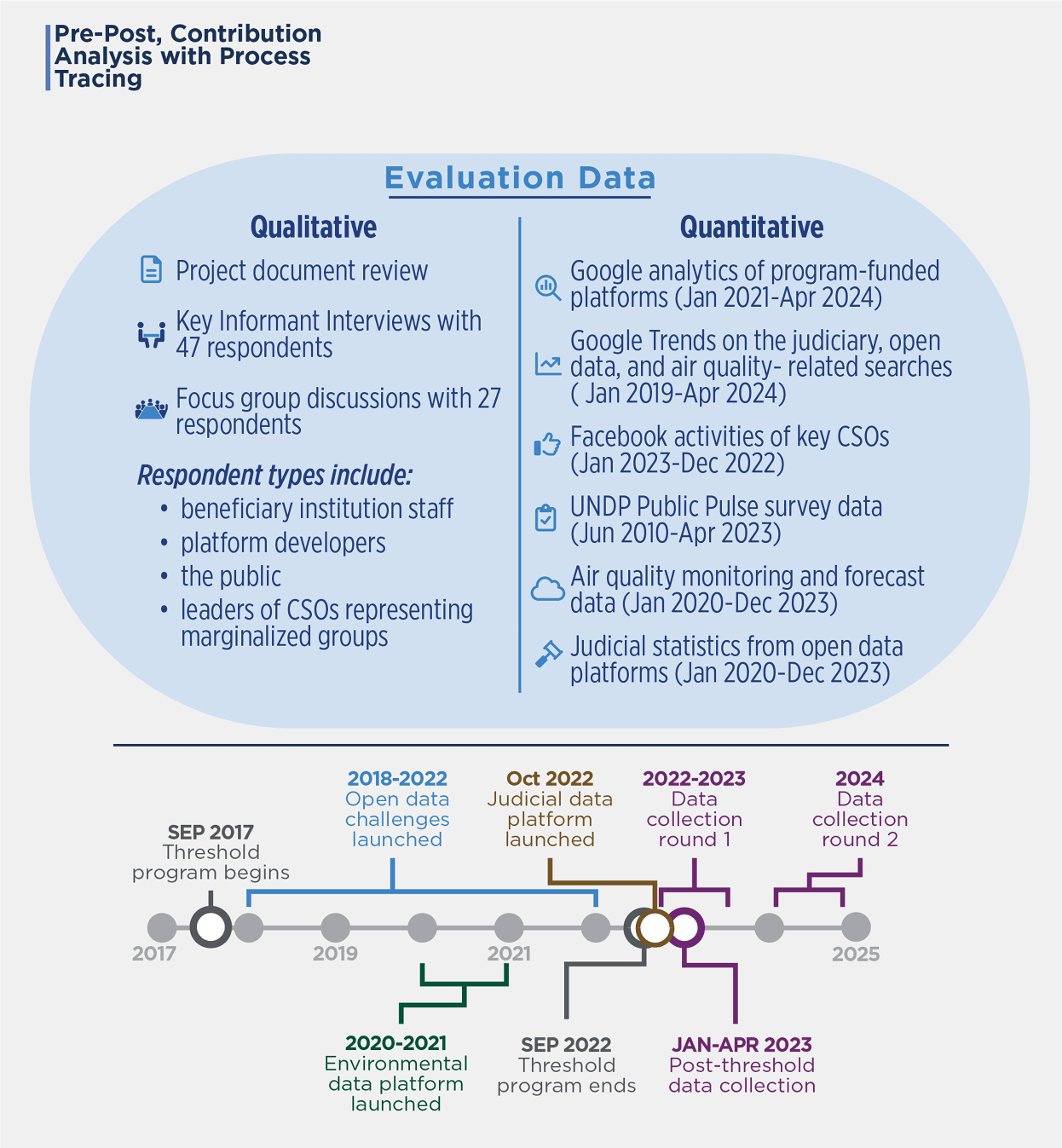
This performance evaluation is a pre-post contribution study with process tracing that uses mixed methods (both quantitative and qualitative data) to assess retrospective and observed impacts. The evaluation used primary and secondary data sources and qualitative and quantitative data types to answer the evaluation questions. The exposure period depends on when data platforms became operational or when sector-specific open data challenges occurred and ranges from 12 – 18 months (judicial data platform), 12 – 36 months (air quality data platform), and 12 – 48 months (open data challenge).
Evaluators collected data between January and April 2023. However, the delayed launch of the judicial data platforms and continued challenges with maintaining the air quality data platforms prompted the evaluators and MCC to determine that another round of data collection was necessary to capture changes which might occur after longer exposure to the project’s interventions. Evaluators conducted a second round of qualitative and quantitative data collection in February 2024 for the judicial data platform and April 2024 for the environmental data platform.
2025-002-3108