




Program Overview
MCC’s $49 million Kosovo Threshold Program (2017-2022) funded the $35.5 million Reliable Energy Landscape Project to reduce the gap between energy supply and demand in Kosovo by piloting incentives to encourage household energy efficiency, switching to district heating, and improving market access for power producers. The project was based on the theory that fostering a market-driven approach to lowering household energy consumption and electricity generation will improve the supply of electricity in Kosovo.
Evaluator Description
MCC commissioned the American Institutes for Research to conduct an independent final impact and performance evaluation of RELP. Full report results and learning: https://evidence.mcc.gov/evaluations/index.php/catalog/273.
Key Findings
Success and Challenges with Project Implementation
- The Reliable Energy Landscape Project (RELP) improved access to energy efficiency retrofits for households in Kosovo despite implementation challenges.
Energy Consumption and Supply Gap
- Despite marginal improvements, the project was too limited in scale to impact national energy demand and supply gaps.
- Contrary to theory of change assumptions, household consumption and spending on electricity increased as households shifted towards on-grid energy.
- Utilization of heat controls in apartments resulted in measurable reduction in thermal energy consumption at the substation level.
Changes in Perceptions and Other Findings
- Households reported improved comfort and living conditions from investments in retrofits and perceive future investments will yield long-term cost savings.
- The project contributed to public and private investments in energy efficiency, but institutional actions are needed to affect household consumption behavior.
- Internships, scholarships, and grants contributed to women’s increased participation in the energy sector.
Evaluation Questions
This final performance and impact evaluation was designed to answer the following questions:
- 1
Were the project’s activities implemented as planned? - 2
Did the project meet the stated objective of reducing the gap between energy demand and supply in Kosovo? - 3
What were the contributions of the various components (including awareness and behavior change outreach) of the project to energy consumption and supply in Kosovo?
Detailed Findings
These findings build upon the baseline evaluation report published in 2023.
Successes and Challenges with Project Implementation
The project retrofitted houses and apartment buildings in 10 provinces across Kosovo to reduce household electricity consumption. As a pilot to identify a scalable model, the project successfully tested cost-effective approaches through several iterations. The initial round offered more retrofit options and grants covering up to 90 percent of costs, but only for 187 households out of the 2600 initially projected. Subsequent rounds capped grants, required 40-50 percent co-investment from households, and saw a higher uptake of retrofits. Ultimately, 962 households received retrofits due to lessons learned and cost adjustments made during implementation. Six municipalities jointly invested in the retrofitting efforts, contributing 121 percent of their cost share. All 26 project targeted apartment buildings were retrofitted.
As of April 2024, heat meters had been installed in 99% of the 17,500 targeted households for district heat metering through the utility company (Termokos) despite delays.
The project launched a credit guarantee window in 2022 with the Kosovo Credit Guarantee Fund and trained staff from 2 commercial banks and 90 energy producers (Auto and Independent Power Producer) to facilitate investments in energy production.
Energy Consumption and Supply Gaps
The project stimulated investment in energy production and reduced household reliance on non-grid sources. However, its limited pilot scale, relative to the size of Kosovo’s energy sector, was insufficient to achieve the objective of reducing the national energy supply-demand gap.
Interrupted time series (ITS) analysis of monthly utility data before and after installations showed increased electricity use and spending in retrofitted houses (see figure on page 2), along with reduced fuel-wood use, suggesting a shift toward electricity for heating and cooking. In contrast, retrofitted apartments saw little to no change in consumption and spending, likely due to reduced central heating and greater use of electric heaters as reported in surveys.
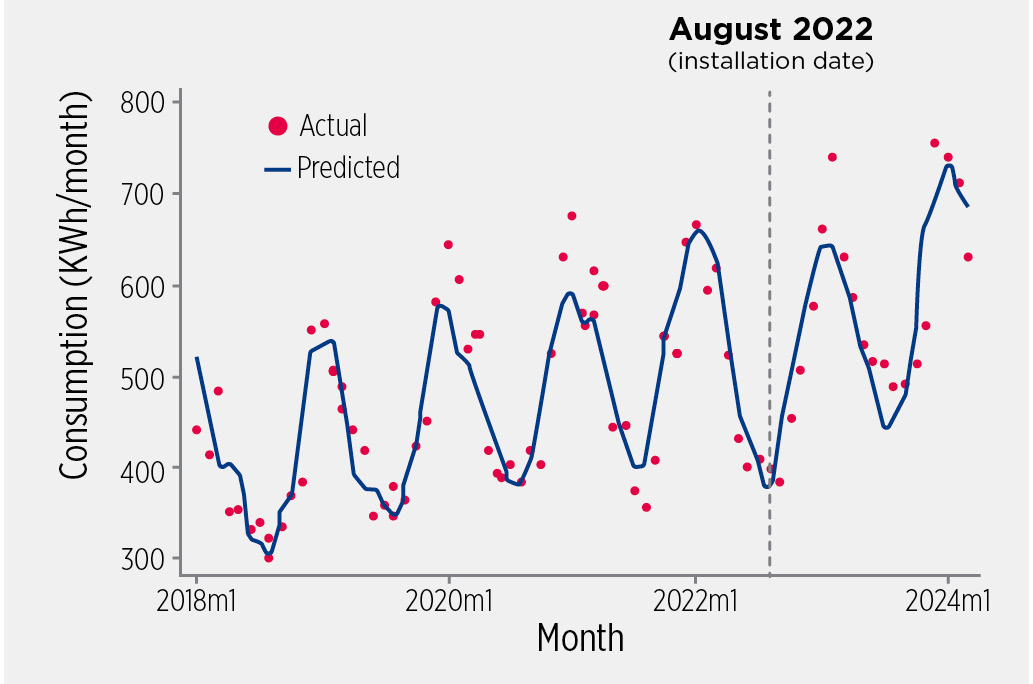
Observed electricity consumption trend for a retrofitted house
Based on trend analysis, substation-level thermal energy consumption declined after the installation of heat controls, while spending remained flat. This evaluation could not effectively examine effects on household-level heat consumption since consumption-based billing has not been enacted in Kosovo as of August 2024.
The guarantee window raised €6 million to back €33.6 million in loans and by April 2024, eight loans were approved: five for small-scale energy generation and three for energy efficiency. The energy generation loans supported small enterprises producing their own power, projected to generate 3,412 kWh annually. However, many businesses perceived investments as unattractive due to regulatory hurdles, lengthy permitting processes, limits on production capacity, and unclear payment rates for the energy produced.
Changes in Perception and Other Findings
Assessment of benefit-cost ratios on energy savings shows retrofit investments are too expensive for the financial value gained, with returns of $0.28 (apartments) and $0.07 (houses) over 10 years for every dollar spent. Yet, households indicated willingness to invest in future retrofits due to long-term energy savings and other perceived non-financial benefits (see figure on page 3). Households (89 % houses, 63% apartments) reported being able to control and heat more of their living space after installations, leading to improved comfort levels. Notably, the substitution between grid and non-grid energy sources led to reduced estimated annual energy expenditures for all retrofitted households per evaluation findings.
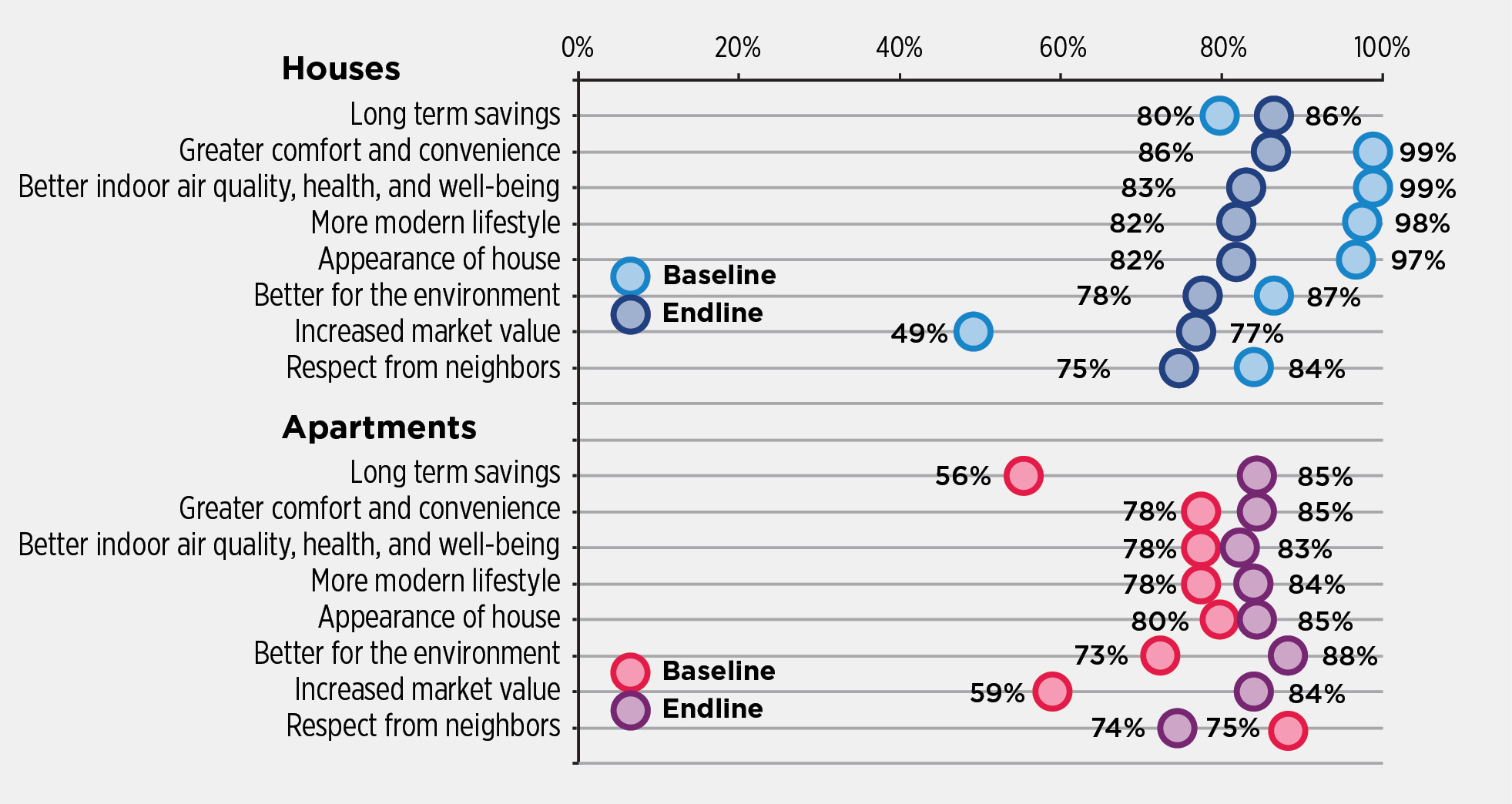
Household goals for investing in energy efficiency retrofits
The evaluation observed evidence to support long-term persistence of project results as well as challenges. In 2023, the Kosovo Energy Efficiency Fund and the Ministry of Energy implemented new energy efficiency subsidies adopting the most cost-effective model and lessons from the project Unfortunately, while findings show customers are motivated to reduce costs, further delays in implementation of consumption-based billing for thermal energy by the utility company could affect expected consumer behavior.
Economic empowerment initiatives supported 384 women-owned business energy efficiency grants, 26 scholarships, and 237 internships and improved women’s awareness and participation in the energy sector. Among the 9 (35%) scholars interviewed at endline, 8 were employed with regular contracts and one was still studying. Over a year since implementation, 8 scholars and 18 interns tracked through endline reported stable employment and career advancement in energy sector-related field.
MCC Learning
When descoping programs from Compact to Threshold, MCC should require relevant adjustments to metrics for measuring project objectives.
Job placement and internship programs should include rigorous vetting and oversight mechanisms of host organizations to ensure meaningful outcomes for both participants and host institution.
Evaluation Methods
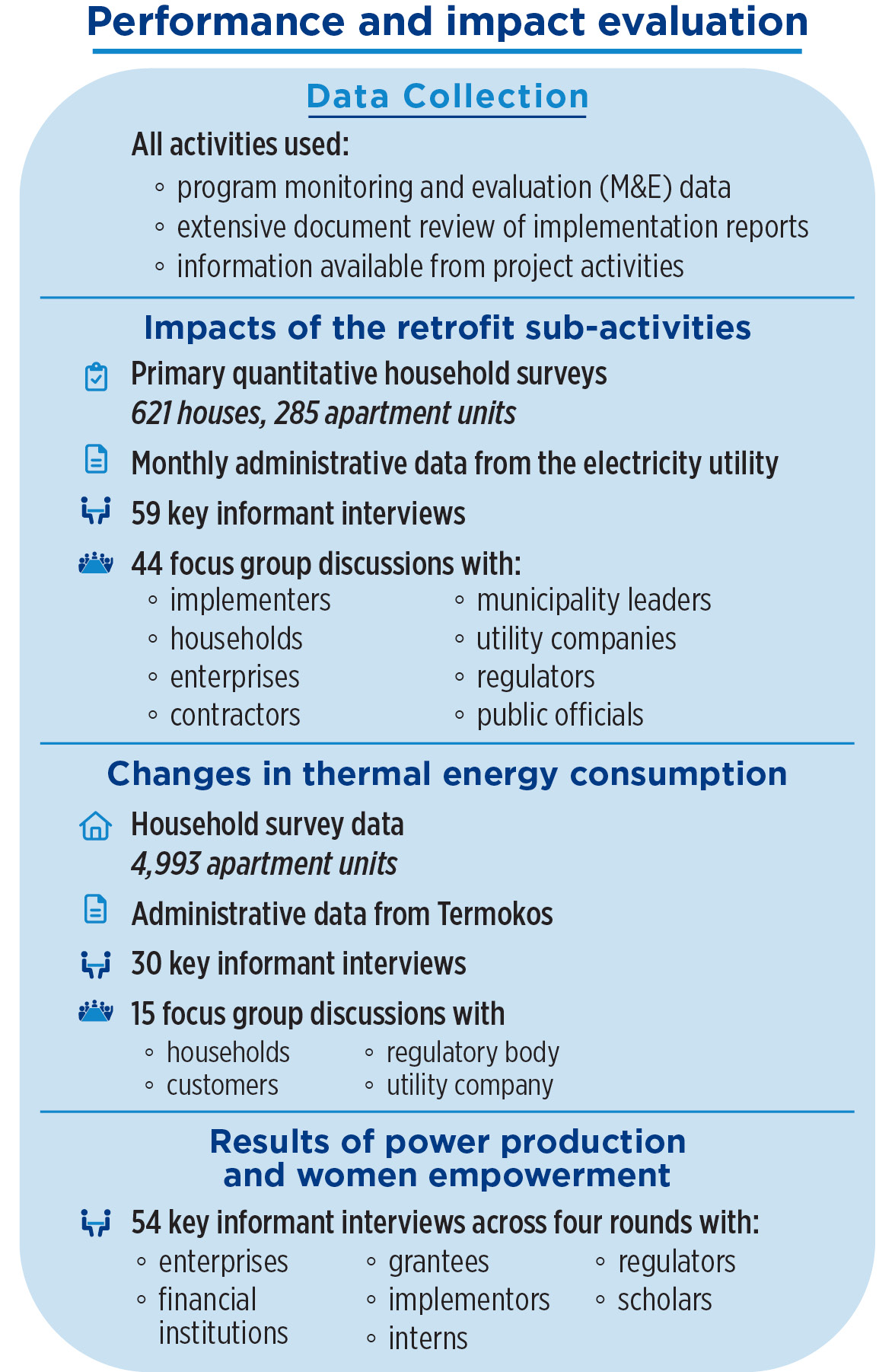
This evaluation is both a performance and impact evaluation consisting of pre-post and quasi-experimental interrupted time series methodologies. Quantitative and qualitative data collection activities occurred between November 2021 – March 2024. Since the activities had varying implementation timelines, the exposure period ranges from 6 to 24 months.
Household and Apartment Energy Retrofits sub-activities were evaluated using the ITS, which compared household electricity consumption and expenditure data before and after energy efficiency retrofit installations. Since retrofits were installed on a rolling basis for households from June 2021 to December 2022, separate analysis was run for each retrofit installation date, with a different number of households being retrofitted each month. Household surveys were also used to explore consumption and expenditure behavior trends.
Thermal energy data from multi-unit sub-stations was analyzed pre-and-post household heat meter installations to estimate project effect on household thermal energy consumption.
2025-002-3107