




Program Overview
MCC’s $311 million Ghana Power Compact (2016-2022) funded the $25.4 million Energy Efficiency and Demand Side Management Project, which aimed to reduce electricity demand through improved building and appliance efficiency, the development of technical capacity of local institutions and professionals for energy audits, and public outreach and education about energy efficiency. These investments were based on the theory that improved knowledge and increased use of energy efficiency products would reduce peak load on the network and lead to energy efficiency improvements.
Evaluator Description
MCC commissioned Mathematica to conduct an independent final performance evaluation of the Energy Efficiency and Demand Side Management Project. Full report results and learning: https://evidence.mcc.gov/evaluations/index.php/catalog/251.
Key Findings
Unmet Energy Savings Targets
- Although the project activities were largely implemented as designed and met or surpassed output and process targets, they were far off from their expected energy savings.
Standards and Labels
- The development and passage of standards and labels legislation to improve the energy efficiency of 20 common appliances was a major accomplishment.
Energy Auditing
- Seven public institutions participated in energy audits and received energy efficiency upgrades, but energy savings have been well below their targets.
Education and Public Information
Streetlights
Evaluation Questions
This final performance was designed to answer the following two questions:
- 1
To what extent was the project implemented according to plan? - 2
Did the project achieve its stated objective of reducing electricity demand? Why or why not?
Detailed Findings
Unmet Energy Savings Targets
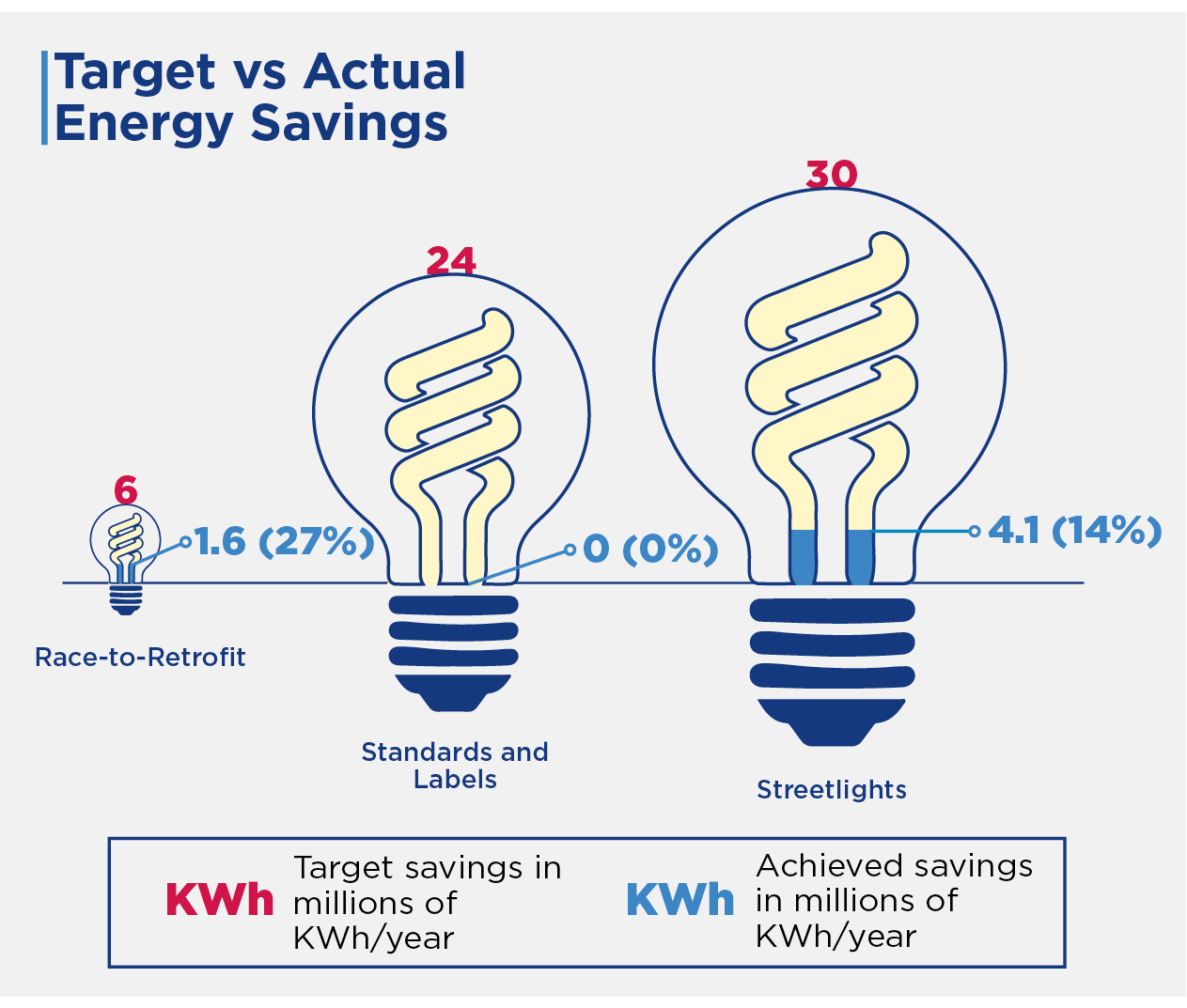
The main objective of the Energy Efficiency and Demand Side Management Project was to lower energy consumption by improving energy efficiency. Although the project was successfully implemented, each of the activities reduced energy consumption by far less than their targets (see figure at right). MCC’s economic rate of return projected reductions in consumption totaling 0.5 to 1 percentage points depending on the year. However, the evaluation found that the actual reduction in consumption was less than 0.15 percentage points. It was unrealistic to expect that the planned activities would lead to this magnitude of change. Implementation delays also contributed to the shortfall.
Standard and Labels
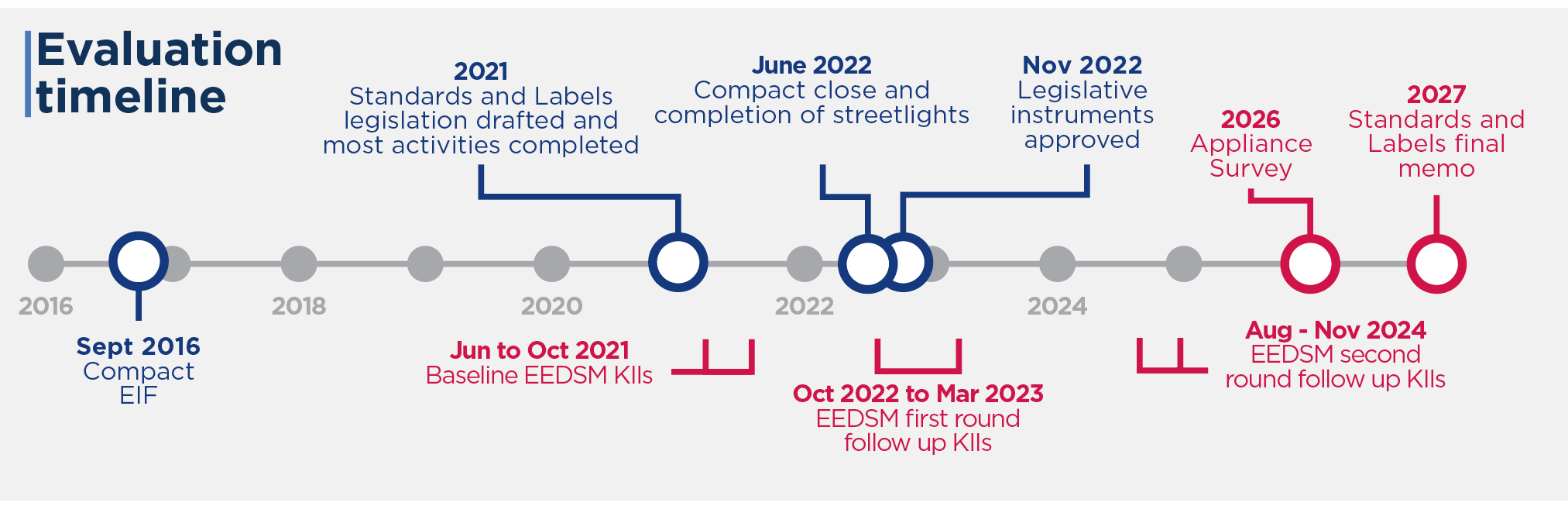
The activity produced standards and labels legislation to regulate and encourage energy efficiency for 20 appliances by the target date of June 2021. However, the Ghanian parliament did not approve the new standards until November 2022, approximately five months after the compact had ended. Although importers and retailers have started to comply with the energy efficiency regulations, stakeholders reported it would take years to achieve considerable compliance and energy savings effects because consumers lack awareness, compliant appliances are more expensive than conventional appliances, and authorities face challenges in enforcing the standards.
Energy Auditing
The compact established three energy auditing centers at Accra Technical University, the University of Energy and Natural Resources, and Kwame Nkrumah University of Science and Technology, which were handed over to the beneficiary universities in July 2022. Although the centers exceeded their output target for trained energy auditing professionals, their ongoing operations have been constrained by lack of dedicated staff and funding. Since their start-up, they have only conducted one round of training, and stakeholders report that resource constraints and weak demand for energy auditing services constrain the scale-up of these activities. As a result, the centers have likely contributed to minimal energy savings.
The Race-to-Retrofit intervention conducted energy audits and retrofits in seven government institutions to reduce their consumption of grid electricity. The implementer estimated that the intervention produced 1.6 million kWh per year in energy savings, but this is well below the compact target of 6 million kWh per year.
Education and Public Information
The energy efficiency curriculum pilot took place in 30 schools and involved support for school clubs, teaching materials, and teacher training. At its conclusion, the number of educators trained exceeded the output target, and the number of students reached was close to the end-of-compact target. However, a lack of funding and national adoption of the curriculum constrains the long-term use and scale-up of the curriculum. At endline, stakeholders did not know whether the 30 pilot schools continued to teach the energy efficiency topics or maintain the student clubs and other activities such as festivals and competitions. Although Ghana’s National Council for Curriculum and Assessment supported a nationwide rollout of the curriculum, the Ministry of Education has not yet sanctioned the enhanced curriculum for scale-up, with stakeholders citing insufficient funding as a key constraint.
Streetlights
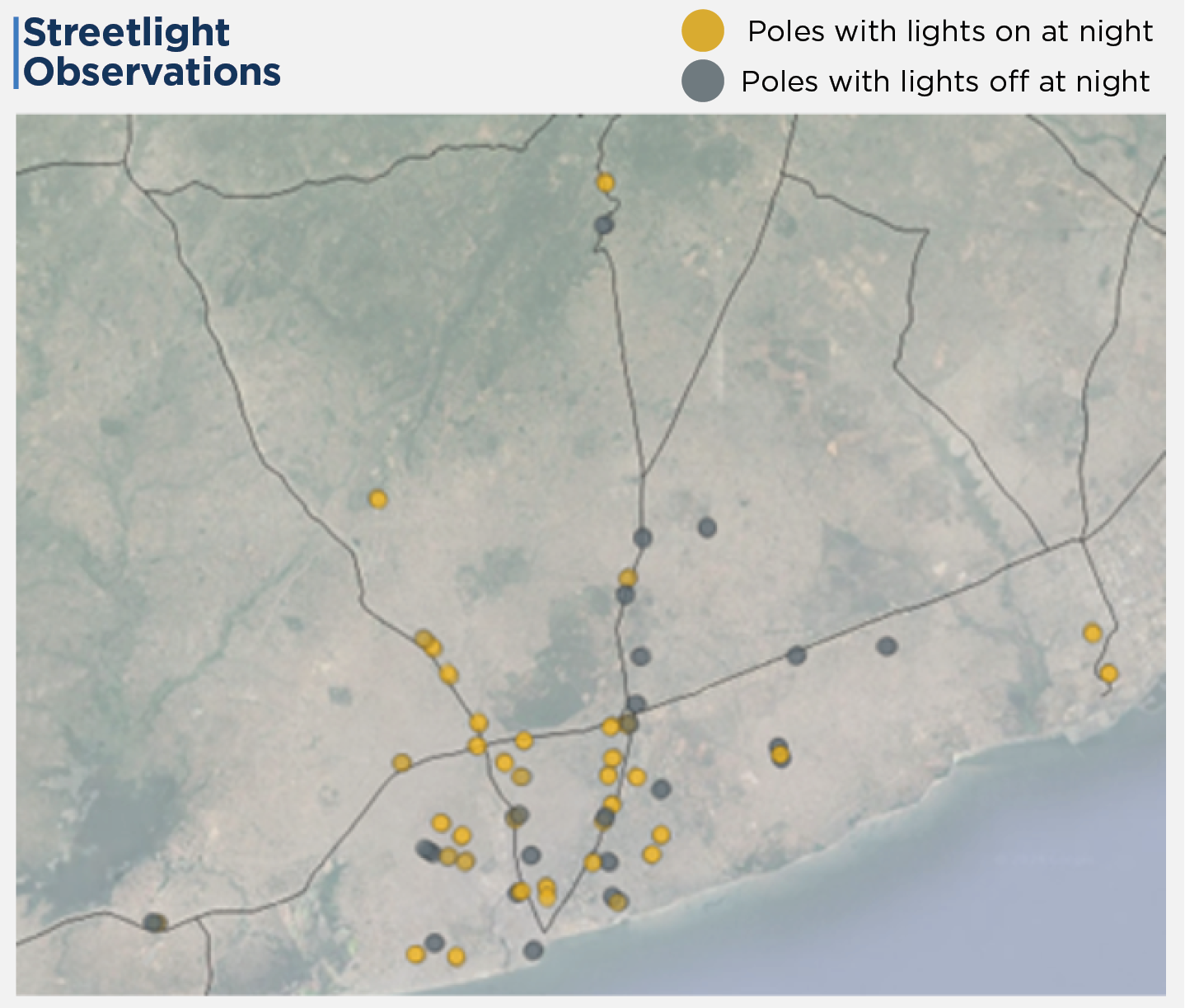
The Demand Side Management Activity exceeded its target of new streetlights installed, but did not meet its target of new streetlight poles constructed. The evaluation estimated that the potential energy saving would be around 8 million kWh per year given the number of new streetlights installed. This estimate is much lower than the activity’s projected target of 30 million kWh. Further, observations of the streetlights as of the end of 2024 found that only half of installed lights were operational at night which suggests that only about half of the potential annual energy savings were realized. The evaluation’s finding of 4.1 million kWh in actual savings per year is about 14 percent of the compact’s target of 30 million kWh per year, even though more LED lights were installed than originally planned.
MCC Learning
Realistic economic models require sufficient project design. Energy savings fell far short of target.
MCC compacts should avoid undertaking an assortment of small, varied activities. The project covered eight distinct interventions, which created an administrative burden and challenged oversight efficiency, given MCC’s management structure.
Validate planned administrative data sources in the evaluation design phase. Energy bills, meter data from streetlights, and other administrative data the evaluation sought to leverage were ultimately unavailable.
Evaluation Methods
This performance evaluation used a mix of quantitative and qualitative methods. The quantitative streetlights analysis drew on streetlight observations conducted in September 2024, covering a representative sample of 390 lights. Analysis for all other activities used qualitative and secondary data and thematic analysis to assess implementation, outcomes, and persistence of results. Data sources included implementation documents and records, press articles identified through a keyword search, and key informant interviews that captured the perspectives of stakeholders involved in the project’s design and implementation. Key informant interviews were conducted over three periods (June 2021 to Oct 2021, December 2022 to March 2023, and August 2024 to November 2024), while documents and press articles were collected throughout the course of the evaluation.
The evaluation captured the outcomes of the project about two years after compact completion, with the exposure period varying by activity from 0 (Standards and Labels) to 4 years (Race-to-Retrofit).
Next Steps
While this is the final report for the Energy Efficiency and Demand Side Management Project, there is a small follow-up evaluation activity that will be completed in 2027. This will consist of a survey on the ownership of energy efficient appliances among enterprises to obtain a more complete picture of the impacts of the Standards and Labels Activity.
2026-002-3142